
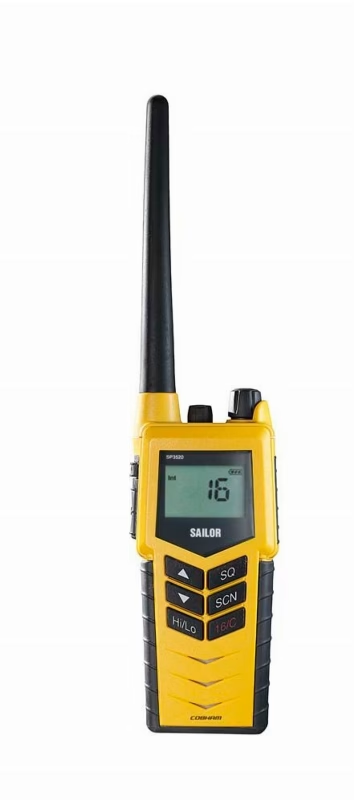
Cobham SAILOR SP3520 GMDSS Marine VHF Radio
A portable marine radio for international GMDSS channels, with a Channel 16 priority key, Dual Watch, Tri Watch, and scanning. It offers 2 W / 1 W output, IP67 protection, and a large display with adjustable red backlight.
Original price was: 4,128.50 SAR.3,921.50 SARCurrent price is: 3,921.50 SAR. incl. VAT
Available on backorder
RISYS can programme and prepare devices before delivery. Contact us for quantity and project details.
Wholesale and project supply — up to 45% off

Fast shipping





Genuine warranty

Secure payment





B2B/B2C supply
Up to 45% off wholesale supply.
Overview
The Cobham SAILOR SP3520 GMDSS marine VHF radio is built around one practical task: giving a vessel team a portable voice link for safety and routine coordination on the international channels required for portable GMDSS VHF operation. A dedicated Channel 16 distress and safety priority key keeps the primary emergency channel directly accessible, while Dual Watch, Tri Watch, and scanning help an operator monitor relevant traffic without repeatedly stepping through channels. The handset transmits at 2 W or 1 W and receives across 155.000-163.425 MHz. Its IP67 protection, resistance to immersion at 1 m for 30 minutes, and operating range from -20°C to +55°C make it a considered choice for exposed marine duties. A large display with adjustable red backlight supports viewing when ambient light changes.
How the Cobham SAILOR SP3520 GMDSS marine VHF radio serves a crew
The portable format lets crew members carry a voice link between the bridge, deck, and work points within the vessel’s tested coverage. An operator can select 2 W when the communications plan calls for the higher transmit level or 1 W when the lower setting suits the task. The Channel 16 key shortens access to the distress and safety channel, which matters when the user is occupied with an operational movement or wearing work equipment. A supplied lanyard and belt clip provide two practical ways to retain the handset during movement. The unit weighs 340 g with the emergency battery, allowing an equipment manager to account for its carried weight and storage position. Familiarity with the priority key and transmit controls should form part of each user’s preparation before duty.
GMDSS channels and the marine VHF operating range
Reception covers 155.000-163.425 MHz, while transmission covers 155.000-161.450 MHz. The radio carries the international channels required for a portable GMDSS VHF under Radio Regulations Appendix 18. That channel arrangement positions the SP3520 for organized marine communications rather than general land-site radio use. A fleet manager can structure normal working-channel procedures while retaining Channel 16 as the distress and safety priority. The radio uses 16K0G3E modulation, with maximum deviation of ±5 kHz and frequency stability better than ±0.7 kHz. These technical limits give a communications team concrete references when matching the handset to a vessel radio plan and conducting service checks. Selectable transmit output also allows a clear operating rule for when each power level should be used.
Monitoring, display, and audio during operations
Dual Watch, Tri Watch, and scanning give the operator distinct ways to follow radio traffic. Dual Watch can be selected when the procedure calls for monitoring two channels, Tri Watch supports a three-channel monitoring arrangement, and scanning steps through the channels prepared for that function. The large display presents radio status, while the adjustable red backlight allows brightness to be adapted as surrounding light changes. Internal audio output is 0.25 W at 10% distortion, and the external audio output is 0.25 W into 8 ohm. An external-equipment interface supports headsets, fist mikes, and hand microphones. Before issue, a fleet team should match the intended accessory to the radio interface and the crew member’s role, then test listening and transmission while the user wears the work equipment required for the task.
Marine uses across Saudi operations
The SP3520 fits teams that need portable VHF communication aboard vessels working in Saudi ports or along coastal routes. It can be assigned to a crew member moving between the bridge and deck or placed within safety equipment that calls for access to the international channels required for a portable GMDSS radio. Service craft and marine support crews can use the Channel 16 priority control when a fast move to the distress and safety channel is required. Dual Watch, Tri Watch, and scanning assist with following the channels defined by the vessel’s procedure. IP67 protection and immersion resistance at 1 m for 30 minutes suit duties where spray or an accidental drop into water is a foreseeable risk within that limit. Coverage should be tested aboard the actual vessel because decks, partitions, and user position shape how units are distributed.
Where the SP3520 sits in the SAILOR handheld range
The selection case for this model centres on a specific role: portable marine VHF operation with international GMDSS channels and direct Channel 16 priority access. It therefore suits a buyer who places safety-oriented marine communication ahead of features intended for land operations or digital workplace networks. IP67 protection, two battery options, and the red-backlit display reinforce that role without changing the handset’s focus on portable voice. When comparing SAILOR handheld equipment, an operations manager can begin with five deployment questions: which channel plan is required, whether direct Channel 16 access is essential, which monitoring mode will be used, which battery suits the assigned duty, and which audio accessory each crew member needs. This keeps the purchasing decision tied to the vessel’s operating procedure instead of treating isolated figures as the whole use case.
Battery options and shift preparation
The radio supports a 3000 mAh primary Lithium Iron Disulfide battery and an 1800 mAh secondary rechargeable Lithium-Ion battery. Its Li battery supply is 7.2 VDC. Current drain is 1.4 A during 2 W transmission, 0.8 A during 1 W transmission, and 0.25 A in receive mode at maximum audio. These values let an equipment manager compare the two output settings and plan battery allocation around the radio’s assigned role and expected transmit-receive pattern. They should not be converted into a fixed shift duration without accounting for the actual duty cycle. Before issue, the selected battery can be checked, the lanyard or belt clip fitted, the backlight adjusted, and the Channel 16 key and monitoring functions exercised. Separating emergency-designated units from routine working units in the vessel’s internal issue process also makes each handset’s role clear.
Environmental limits and commissioning checks
The SP3520 operates from -20°C to +55°C and combines an IP67 rating with immersion resistance at 1 m for 30 minutes. Those boundaries inform storage and carrying decisions, while a unit exposed to water should still be checked before returning to duty. Antenna-port impedance is 50 ohm, a value the technical team can account for during radio-frequency checks. Typical receiver sensitivity is -117 dBm at 20 dB SINAD. Spurious-response rejection and adjacent-channel selectivity are both greater than 70 dB, while receiver intermodulation is better than 70 dB. Transmitter adjacent-channel power is greater than 70 dB, and spurious emission is below 0.25 µW. A maintenance team can use these limits during acceptance and periodic testing, then document transmit, receive, audio, control, and battery checks before the radio is assigned back to a crew member.
Technical Specifications
- Brand
- Cobham SAILOR
- Model
- SP3520
- IP Rating
- IP67
- Frequency Band
- VHF
- Power Output
- 2 W
- Battery Details
- Primary Lithium Iron Disulfide 3000 mAh battery; secondary rechargeable Lithium-Ion 1800 mAh battery
- Display
- Large display with adjustable red backlight
Frequently Asked Questions
Which channels does the Cobham SAILOR SP3520 support?
It supports the international channels required for a portable GMDSS VHF under Radio Regulations Appendix 18, with a dedicated Channel 16 priority key.
What water and dust protection does the SP3520 provide?
The radio is rated IP67 and withstands immersion at 1 m for 30 minutes.
Which battery options are available for the SP3520?
It supports a 3000 mAh primary Lithium Iron Disulfide battery and an 1800 mAh secondary rechargeable Lithium-Ion battery.
How can the SP3520 monitor more than one channel?
It provides Dual Watch, Tri Watch, and scanning, plus a direct priority key for Channel 16 distress and safety traffic.

Cobham SAILOR
Cobham SAILOR is Cobham Satcom's maritime radio and satellite brand, covering VSAT and L-band terminals, GMDSS and VHF radios, AIS and Navtex.
Browse brand productsShipping, Warranty and Regulatory
Delivery inside Riyadh
Clear warranty
Some devices or frequencies may require a permit or approval depending on the intended use and the regulations in force in the Kingdom. Requirements are clarified before project orders are fulfilled.
Customer Reviews
No ratings yet for this product
Only logged in customers who have purchased this product may leave a review.
Related Products
Entel DX544-IS UL913 Marine VHF Handheld Radio
On backorder
Entel DT944 ATEX Marine VHF Handheld Radio
On backorder
GME GX875 Floating Handheld VHF Marine Radio IPX8
On backorder
Reviews
There are no reviews yet.