
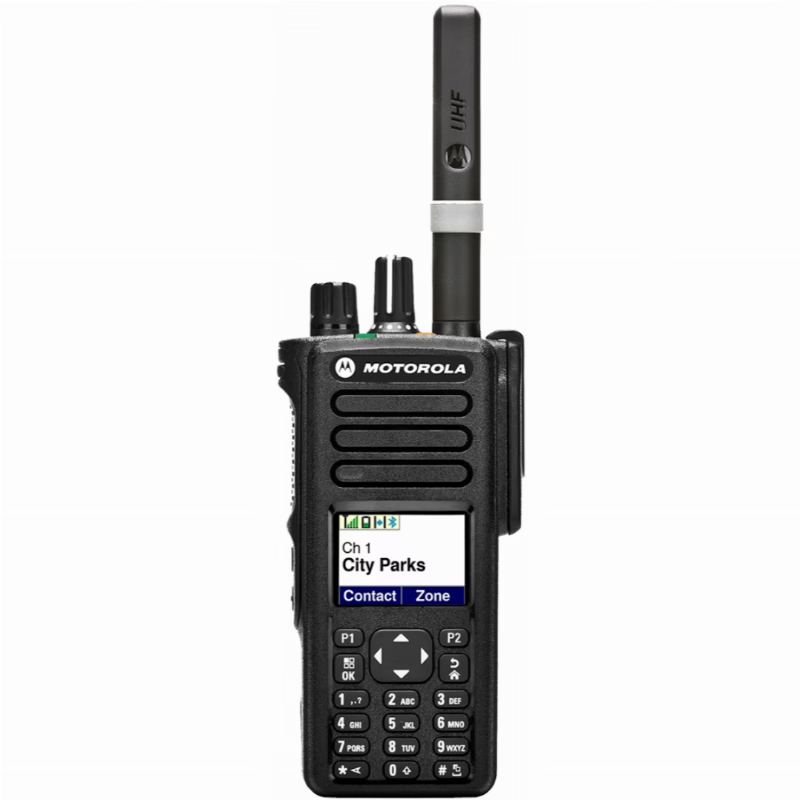
Motorola DP4800 DMR Two-Way Radio with IP57
A digital and analogue handheld with 1000 channels, GPS, Bluetooth, and a colour display across VHF, UHF, and 800 MHz variants. IP57 and MIL-STD-810 testing support field use, while its discontinued status makes lifecycle planning important.
Original price was: 2,817.50 SAR.2,677.20 SARCurrent price is: 2,677.20 SAR. incl. VAT
Available on backorder
RISYS can programme and prepare devices before delivery. Contact us for quantity and project details.
Wholesale and project supply — up to 45% off

Fast shipping





Genuine warranty

Secure payment





B2B/B2C supply
Up to 45% off wholesale supply.
Overview
The Motorola DP4800 DMR Two-Way Radio combines practical environmental resistance with unusually broad fleet-planning flexibility. Its IP57 rating, -30°C to +60°C operating range, and MIL-STD-810 C/D/E/F/G testing give operations managers clear boundaries for demanding field roles. The radio also brings together DMR digital and analogue operation, a colour display, GPS, Bluetooth 2.1+EDR Class 2, and 1000 channels. Available band variants cover VHF 136-174 MHz, UHF 403-527 MHz, and 800 MHz 806-870 MHz. A 1 W low setting sits alongside high output of 5 W on VHF or 4 W on UHF. Those choices let a buyer match the handset to an established network, channel plan, and shift pattern rather than forcing one configuration across every role. DP4800 is discontinued, so it is best assessed with lifecycle needs in view.
How the Motorola DP4800 DMR Two-Way Radio Supports Teams
DP4800 is suited to organisations that need to organise many workgroups from a single handheld platform. Its 1000-channel capacity gives a radio manager room to separate security, maintenance, facilities, logistics, and site zones instead of pushing unrelated traffic through a small shared set. The colour display provides a visual interface for working with that larger channel plan, helping users confirm where they are operating before transmitting. DMR digital and analogue modes allow the device to participate in a planned migration or a fleet where both modes remain in use. GPS provides location capability for functions built around positioning, while Bluetooth 2.1+EDR Class 2 offers wireless connectivity for compatible accessories. For deployment, managers can assign only the channels and operating choices required by each role, then train users to recognise the correct workgroup on the display. That approach turns the headline capacity into controlled communications rather than an unnecessarily complex menu for every employee.
Band, Power, and Channel Planning
DP4800 variants cover VHF 136-174 MHz, UHF 403-527 MHz, and 800 MHz 806-870 MHz. These are purchasing choices that must be matched to the site’s established radio infrastructure and authorised channel plan; they should not be treated as a promise that every unit covers all bands. Output can be set to 1 W at low power, with high output reaching 5 W for VHF or 4 W for UHF. Channel spacing supports 12.5 and 25 kHz. Together, these values give the radio coordinator the inputs needed to prepare the appropriate profile for the network in use. Power alone does not establish real site coverage, because walls, steel structures, floor layout, and antenna position affect performance. A sensible rollout therefore includes coverage checks along critical routes such as gates, plant rooms, loading areas, and external yards using the exact band variant that will be issued. The final channel and power plan can then follow observed operating needs.
IMPRES Battery Choices for Shift Planning
IMPRES Li-ion battery options are available at 1500, 2150, and 2300 mAh, with published operating time changing by capacity and radio mode. The 1500 mAh option provides 7.7 h in analogue operation and 11.3 h in digital operation. Moving to 2150 mAh raises those figures to 11.1 h analogue and 16.2 h digital. The 2300 mAh option provides 11.9 h analogue and 17.3 h digital. This lets an equipment manager match battery selection to the actual shift and the expected balance between digital and analogue use instead of giving every role the same pack. Shorter duties or roles with charging access may suit the smaller option, while longer assignments can be planned around the higher-capacity packs. Battery choice also affects handset depth. Height and width remain 130.3 x 55.2 mm, but depth is 35.8 mm with the 1500 mAh pack and 41.1 mm with the 2150 or 2300 mAh pack. Holsters and storage slots should be checked against the chosen configuration.
Fit for Saudi Operational Environments
The IP57 rating makes DP4800 relevant to duties involving dust and water exposure within the limits of that classification. Its -30°C to +60°C operating range gives Saudi facilities teams a concrete temperature envelope for hot external sites as well as controlled indoor areas. In an industrial facility, the 1000-channel capacity can separate supervision, maintenance, safety, and support functions. Warehouses and logistics yards can select the VHF or UHF variant that matches their existing network and test coverage between receiving, storage, and dispatch zones. Across campuses and large facilities, the colour display helps users navigate a structured channel plan, while GPS can support workflows that use location information. MIL-STD-810 C/D/E/F/G testing adds another durability reference for roles that involve regular movement and changing conditions. The handset should still be handled, cleaned, and stored according to its IP57 boundary and operating-temperature limits; it is not a substitute for a model selected specifically for prolonged submersion.
Where DP4800 Sits Among the Named Motorola Models
DP4800 stands apart from lower-capacity family members by combining 1000 channels with a colour display, GPS, Bluetooth, and dual digital-analogue operation. Compared with GP340 and GP328, its selection case centres on a larger channel structure and a more connected, screen-led handheld workflow. The environmental comparison needs more care. DP4800 is rated IP57, while named siblings such as DP4801Ex, DP4401-EX, and DP3661E offer protection profiles intended for more severe water exposure. Buyers whose first requirement is intrinsic safety or a higher submersion rating should assess those models for that role. DP4800 instead balances its environmental protection with multiple band variants, selectable power, three battery capacities, and wireless connectivity. Some named products, including DM4601E and DP4801Ex, also serve large channel plans, but their form and deployment purpose differ. DP4800 is therefore the fit for an existing fleet that values a feature-rich handheld and broad configuration choice within an IP57 boundary.
Deployment and Product-Lifecycle Notes
Because DP4800 is discontinued, its clearest role is often supporting an established fleet or replacing a matching unit where the organisation has already standardised on the model. Deployment begins by confirming the correct band variant, then defining 12.5 or 25 kHz channel spacing, power settings, and the digital and analogue channel plan. The 1500, 2150, or 2300 mAh battery can be assigned according to shift length, with holsters checked against the related 35.8 or 41.1 mm depth. GPS, Bluetooth 2.1+EDR Class 2, and the colour display should be tested in the exact operating profile issued to users, followed by a coverage trial at critical site points. Asset instructions can record the -30°C to +60°C operating limits, IP57 protection, and selected battery configuration. This creates a controlled basis for keeping DP4800 productive in a current fleet while allowing procurement and operations teams to plan future support and replacement decisions deliberately.
Technical Specifications
- Brand
- Motorola
- IP Rating
- IP57
- Channels
- 1000
- Frequency Band
- Dual Band (VHF/UHF)
- Power Output
- 5 W
- Radio Technology
- Dual-mode: analog and digital (DMR)
- Model
- DP4800
- Battery Details
- IMPRES Li-ion; 1500, 2150 or 2300 mAh options
- Display
- Colour display
Frequently Asked Questions
Which frequency bands are available for the Motorola DP4800?
Variants cover VHF 136-174 MHz, UHF 403-527 MHz, and 800 MHz 806-870 MHz, so the selected unit must match the site's radio network.
How many channels does DP4800 provide, and which modes does it support?
It provides 1000 channels and supports both DMR digital and analogue operation with 12.5 and 25 kHz channel spacing.
What battery options and runtimes are available for DP4800?
IMPRES Li-ion options are 1500, 2150, and 2300 mAh, ranging from 7.7 h analogue with 1500 mAh to 17.3 h digital with 2300 mAh.
What environmental protection does the DP4800 provide?
It is rated IP57, tested to MIL-STD-810 C/D/E/F/G, and specified for operation from -30°C to +60°C.
Is the Motorola DP4800 a current model?
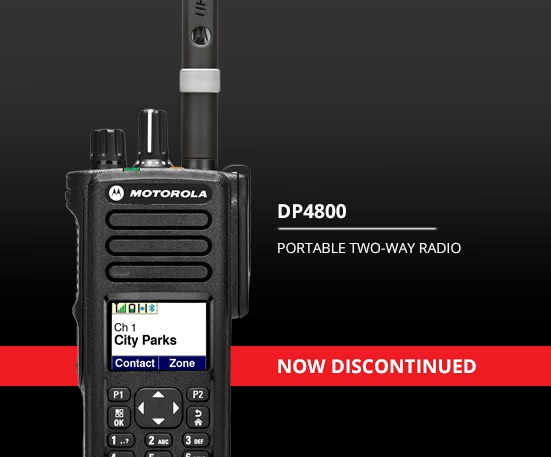
DP4800 is discontinued, so buyers should assess it in the context of supporting an existing fleet and planning the model's lifecycle.

Motorola
Motorola Solutions is a safety and security technology company making two-way radios, radio systems, video security and command-center software.
Browse brand productsShipping, Warranty and Regulatory
Delivery inside Riyadh
Clear warranty
Some devices or frequencies may require a permit or approval depending on the intended use and the regulations in force in the Kingdom. Requirements are clarified before project orders are fulfilled.
Customer Reviews
No ratings yet for this product
Only logged in customers who have purchased this product may leave a review.
Related Products
Motorola GP340 16-Channel Analog Handheld Radio
In stock — Delivery within 1–3 days
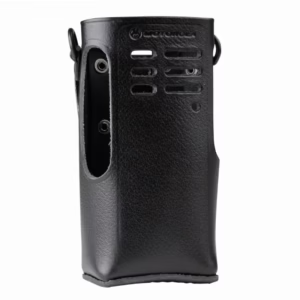
Motorola HLN9665A Leather Radio Case with Belt Loop
On backorder
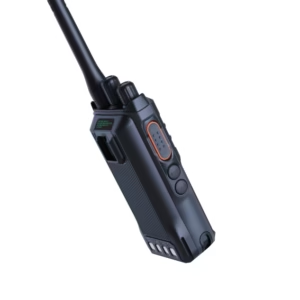
Hytera HP56X UL913 Intrinsically Safe DMR Radio
On backorder
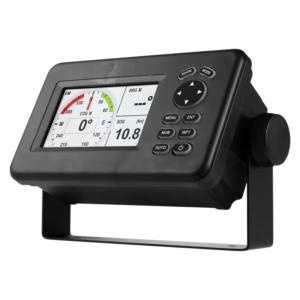
Matsutec HP-528A Marine AIS Transponder & GPS Plotter
On backorder
Reviews
There are no reviews yet.